

MRR (monthly recurring revenue) is the predictable subscription income a business expects each month. To calculate it, add up the monthly value of every active recurring subscription: MRR = paying customers × ARPU. Divide annual plans by 12. Leave out one-time fees and free trials. Below you'll find the formula, a worked example, and the mistakes that trip up most founders.
Last updated: 2026. Written by the MyTools editorial team. Educational content only, not financial, tax, accounting, or valuation advice.
MRR Definition: What Does MRR Stand For?
MRR is the normalized monthly value of all active, recurring subscription revenue. It shows how much predictable income your subscriptions generate in a typical month. It ignores one-time charges, free trials, and the timing of cash. Because it flattens billing quirks into one number, MRR is the headline metric for any Software as a service business, and it is the first number most MRR SaaS dashboards show.
A quick note on terms: in this guide, MRR means monthly recurring revenue only. In digital marketing circles, "MRR" sometimes stands for master resell rights. That is unrelated.
Why Solo SaaS Founders Watch It
I run a directory for indie builders, and I keep seeing the same pattern. Founders who check MRR weekly make calmer calls on pricing, support time, and what to build next. One number tells you whether the business grew or shrank this month. If you are a solo founder, that clarity saves hours.
The MRR Formula
Start with the simplest version:
MRR = number of paying customers × average revenue per user (ARPU)
The movement version explains why MRR changed:
Net new MRR = New MRR + Expansion MRR − Contraction MRR − Churned MRR
Ending MRR = Starting MRR + Net new MRR
| Component | Plain-English meaning |
|---|---|
| New MRR | Monthly value from customers who subscribed for the first time this month |
| Expansion MRR | Extra monthly value from existing customers (upgrades, add-ons, more seats) |
| Contraction MRR | Monthly value lost when existing customers downgrade but stay |
| Churned MRR | Monthly value lost when customers cancel entirely |
How to Calculate MRR in 5 Steps
- List every active subscription for the month.
- Convert annual or quarterly plans to a monthly amount.
- Exclude one-time fees and free trials.
- Add the monthly amounts together. That total is your MRR.
- Record the month's movements: new, expansion, contraction, and churned.
Worked Example With Illustrative Numbers
These numbers are made up for teaching. They are not real data or a benchmark.
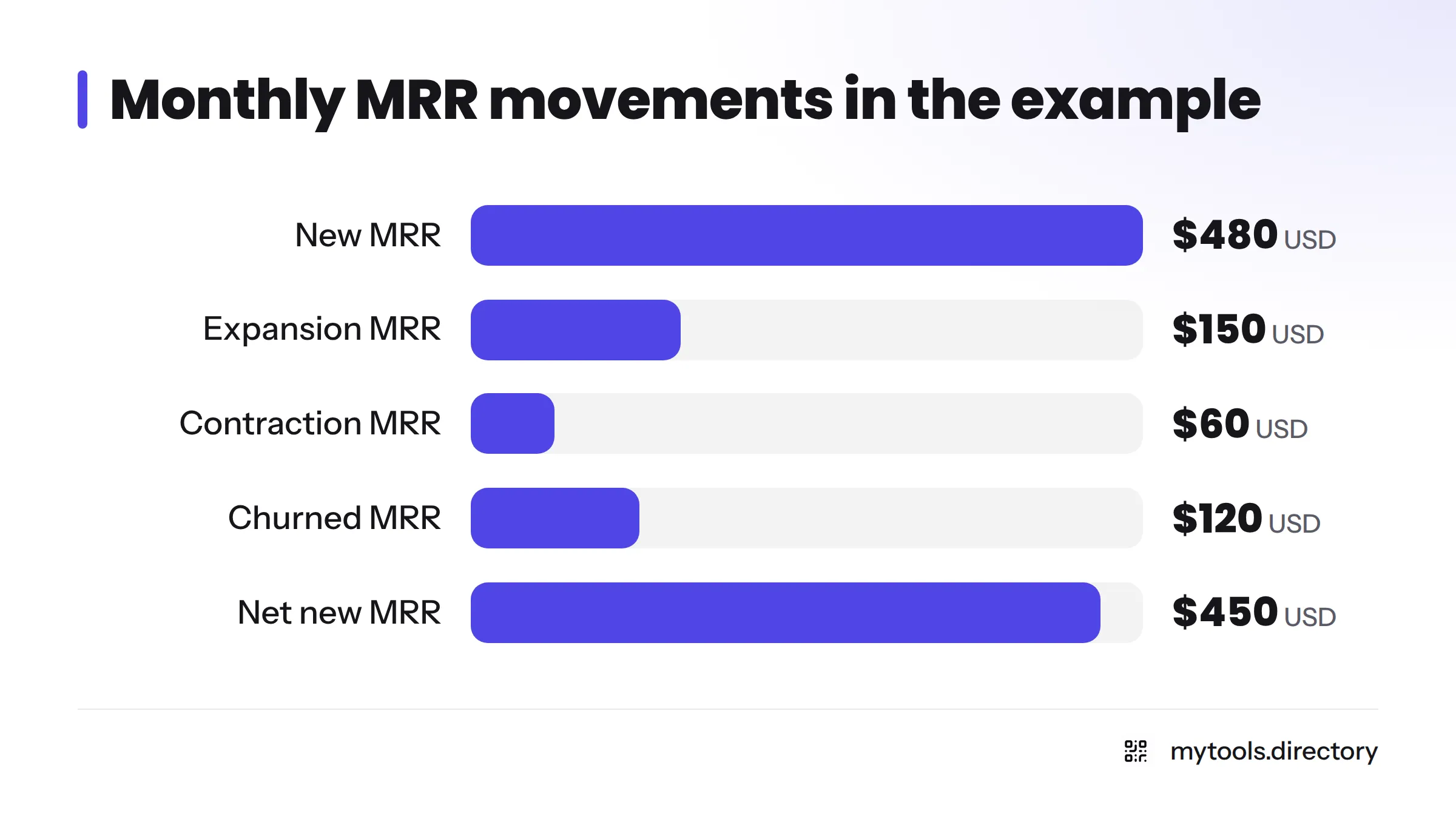
Say a small SaaS starts the month at $5,000 MRR.
| Line | Amount |
|---|---|
| Starting MRR | $5,000 |
| + New MRR (12 new customers) | $480 |
| + Expansion MRR (upgrades) | $150 |
| − Contraction MRR (downgrades) | $60 |
| − Churned MRR (cancellations) | $120 |
| Net new MRR | $450 |
| Ending MRR | $5,450 |
The math: $480 + $150 − $60 − $120 = $450. Then $5,000 + $450 = $5,450.
Normalizing an Annual Plan to Monthly
A customer pays $588 upfront for a one-year plan. Your cash jumps by $588 that day, but your MRR rises by only:
$588 ÷ 12 = $49 per month
Quarterly plans work the same way. A $147 quarterly plan is $147 ÷ 3 = $49 per month.
What Counts Toward MRR (and What Doesn't)
| Item | Counts? | Why |
|---|---|---|
| Monthly subscription | Yes | Recurring by design |
| Annual plan | Yes, divided by 12 | Normalized to a monthly value |
| Upgrades and add-ons | Yes | Recorded as expansion MRR |
| One-time setup fee | No | Not recurring |
| Free trial | No | No payment is committed yet |
| Usage-based charges | Judgment call | Varies month to month |
| Discounts | Yes, net of discount | Count what the customer actually pays |
| Refunds | Adjust | Remove the affected amount from the month |
| Failed payments | Judgment call | Pick a rule and apply it consistently |
Judgment calls: Many founders count only the committed base fee of a usage plan and track overage separately. Whatever rule you pick, write it down and apply it every month. Consistency matters more than the specific rule. For how subscriptions and billing intervals are structured, see Stripe's subscriptions documentation.
Common MRR Calculation Mistakes
Here is where most founders slip:
- Counting annual cash as monthly. A $588 payment is $49 of MRR, not $588. Divide by 12.
- Including one-time fees. Setup, onboarding, and consulting charges do not recur.
- Counting free trials. Add them when they convert to paid.
- Confusing MRR with cash received. MRR is a normalized run rate. Cash depends on billing dates.
- Double counting upgrades. Record only the difference as expansion MRR, not the full new plan price again.
- Changing your rules mid-year. Switching how you treat usage charges makes trends meaningless.
MRR vs ARR, ARPU, and Churn: Related Metrics
| Metric | What it answers | Formula |
|---|---|---|
| MRR | How much recurring revenue per month? | Sum of normalized monthly subscriptions |
| ARR | What is the yearly run rate? | MRR × 12 |
| ARPU | What does the average customer pay? | MRR ÷ paying customers |
| Net new MRR | Did recurring revenue grow this month? | New + Expansion − Contraction − Churned |
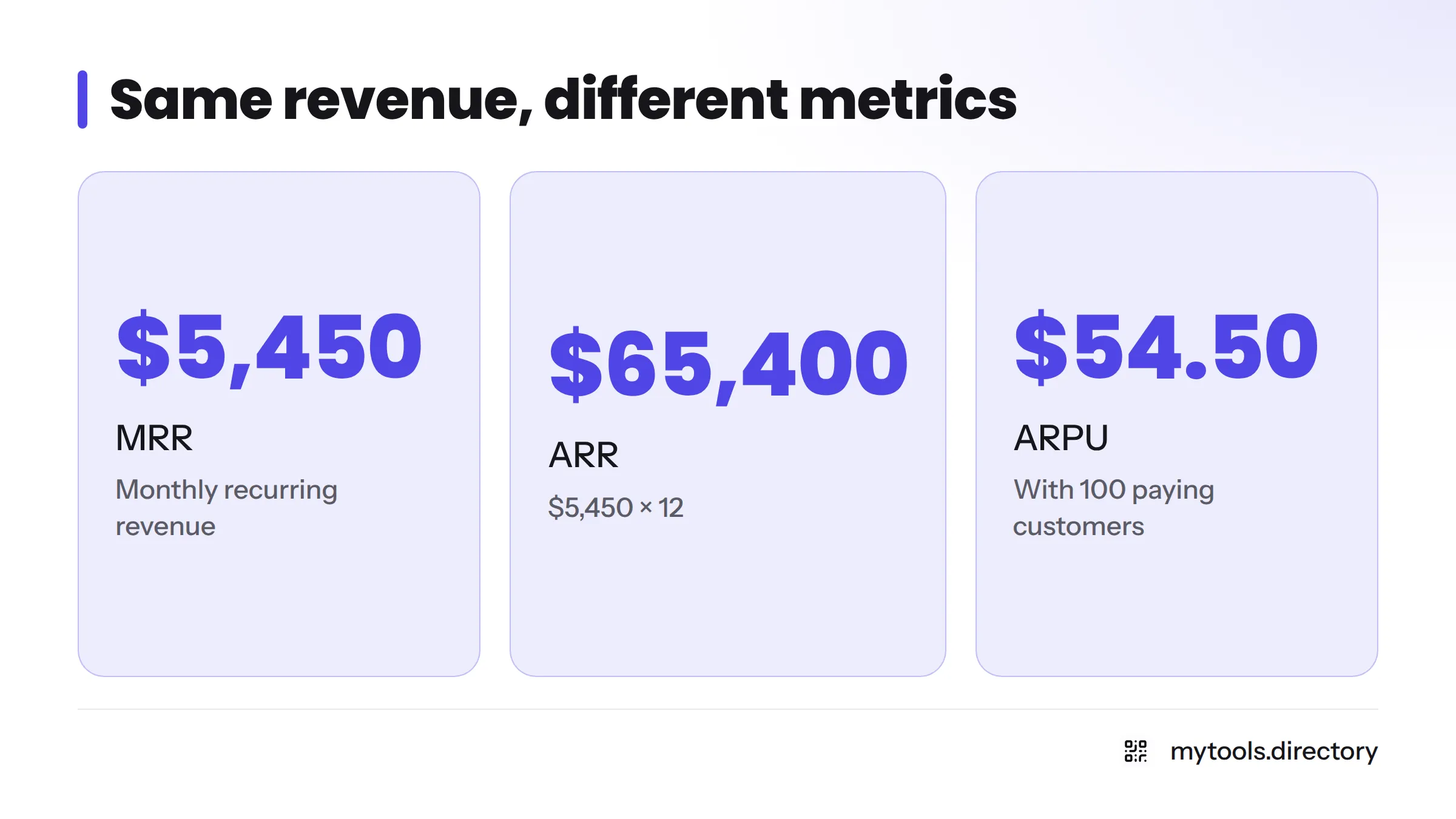
MRR vs ARR: both describe the same revenue on different time scales. $5,450 MRR equals $65,400 ARR ($5,450 × 12). Use MRR for monthly decisions and ARR for yearly framing.
MRR vs ARPU: MRR is a total, while ARPU is the average per customer. With $5,450 MRR and 100 paying customers, ARPU is $54.50.
Churn rate measures how many customers, or how much revenue, you lose over a period. It deserves its own guide, so watch for our churn rate guide rather than treating churned MRR as the whole story.
Tracking MRR as a Solo SaaS Founder With Indie-Built Analytics Tools
You don't need an enterprise finance stack. A spreadsheet plus your billing export works fine at the start. Let's break it down into a monthly routine:
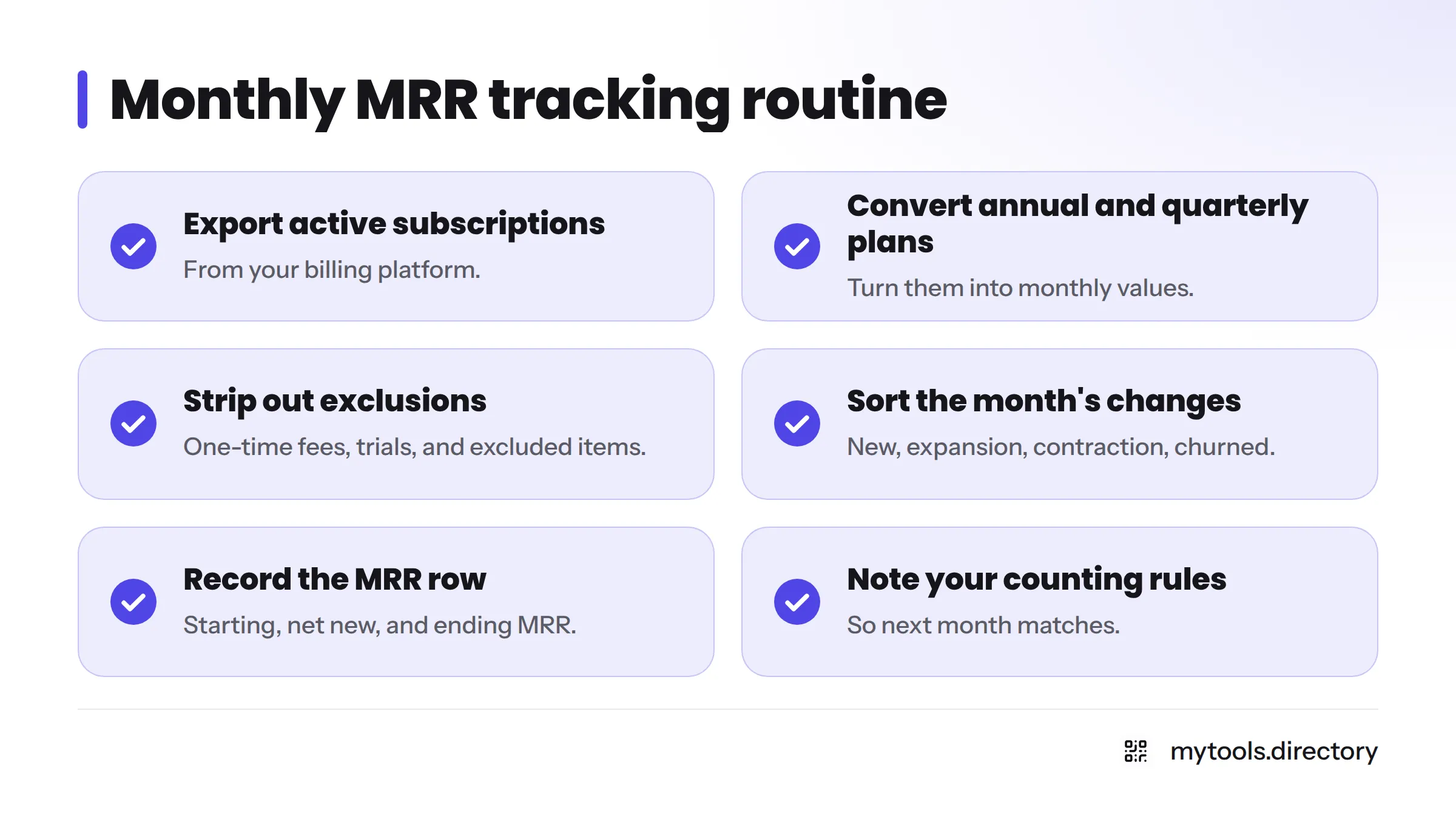
- Export active subscriptions from your billing platform.
- Convert annual and quarterly plans to monthly values.
- Strip out one-time fees, trials, and anything your rules exclude.
- Sort the month's changes into new, expansion, contraction, and churned MRR.
- Record starting MRR, net new MRR, and ending MRR in one row.
- Note your counting rules so next month matches.
The MyTools catalogue lists indie-built analytics tools, and Datafast analytics is one of them. Browse the growth tools for indie SaaS hub to see what else is listed. If you like sharing progress openly, a monthly MRR post is a classic way to build in public. You can also look through the wider MyTools directory for more indie products.
Next steps: read our churn rate guide when it goes live, then pick an analytics tool from the growth-tools hub.
MRR FAQ
What does MRR stand for in finance and SaaS? MRR stands for monthly recurring revenue. It is the predictable subscription revenue a business earns each month.
How do you calculate monthly recurring revenue from annual plans? Divide the annual price by 12. A $588 yearly plan adds $49 to MRR each month.
Does MRR include one-time setup fees? No. One-time fees do not recur, so they stay out of MRR.
Are free trials counted in MRR? No. Count a trial only after it converts to a paid subscription.
How are usage-based charges treated? It is a judgment call. Many founders count only the committed base fee and track variable usage separately. Pick one rule and keep it.
What is net new MRR? Net new MRR is New MRR plus Expansion MRR, minus Contraction MRR and Churned MRR. It shows whether recurring revenue grew or shrank in the period.
How do you convert MRR to ARR? Multiply MRR by 12.
What is considered a good MRR? It depends on your stage, pricing, and goals. The most useful benchmark is your own trend: is net new MRR positive month after month? We skip generic targets because they vary widely and need a reliable source.
Is MRR the same as cash received or profit? No. MRR is a normalized run rate of subscription revenue. Cash depends on when customers pay, and profit subtracts your costs.
How often should I calculate MRR? Monthly at minimum. Many solo founders also check weekly to catch cancellations early.
All numbers in this article are illustrative. This guide is educational and not financial, tax, accounting, or valuation advice.