Product Hunt Alternatives for Indie Makers in 2026
The best Product Hunt alternatives for an indie maker in 2026 are Uneed for a steady, community-voted launch, Microlaunch for small, low-pressure launches, and Tiny Startups for a simple founder-audience listing. LaunchDirectories and AI Launch Space cover broad and AI-specific reach. Hacker News Show HN, Indie Hackers and BetaList handle technical feedback, community and pre-launch testing.
Ever refreshed a Product Hunt page at 3 a.m., waiting on upvotes that never came? This list is for you. I run MyTools, a directory where indie makers submit their products, so I see where solo founders actually launch. Here is how I ranked the options, and how to pick the right one fast.
Quick Picks: Sites Like Product Hunt for Indie Makers
Each line names a platform and the one thing it does best.
- Uneed: a steady, community-voted launch without a single winner-take-all day.
- Microlaunch: small, low-pressure launches for early products.
- Tiny Startups: a simple listing in front of a founder audience.
- LaunchDirectories: broad reach across many listing sites.
- AI Launch Space: a home for AI products.
- Hacker News Show HN: blunt, technical feedback from developers.
- Indie Hackers: community, build-in-public posts and peer support.
- BetaList: early testers and waitlist signups before launch.
Want the wider field? Browse our index of startup directories and launch platforms. Ready to list something now? Submit your product to MyTools.
How I Ranked These Product Hunt Competitors
Two terms first. A launch platform is a site built around a dated launch event, often with voting. A startup directory is a standing listing that people browse or search over time. Many sites act as both, so I judged each one by how it treats a solo maker.
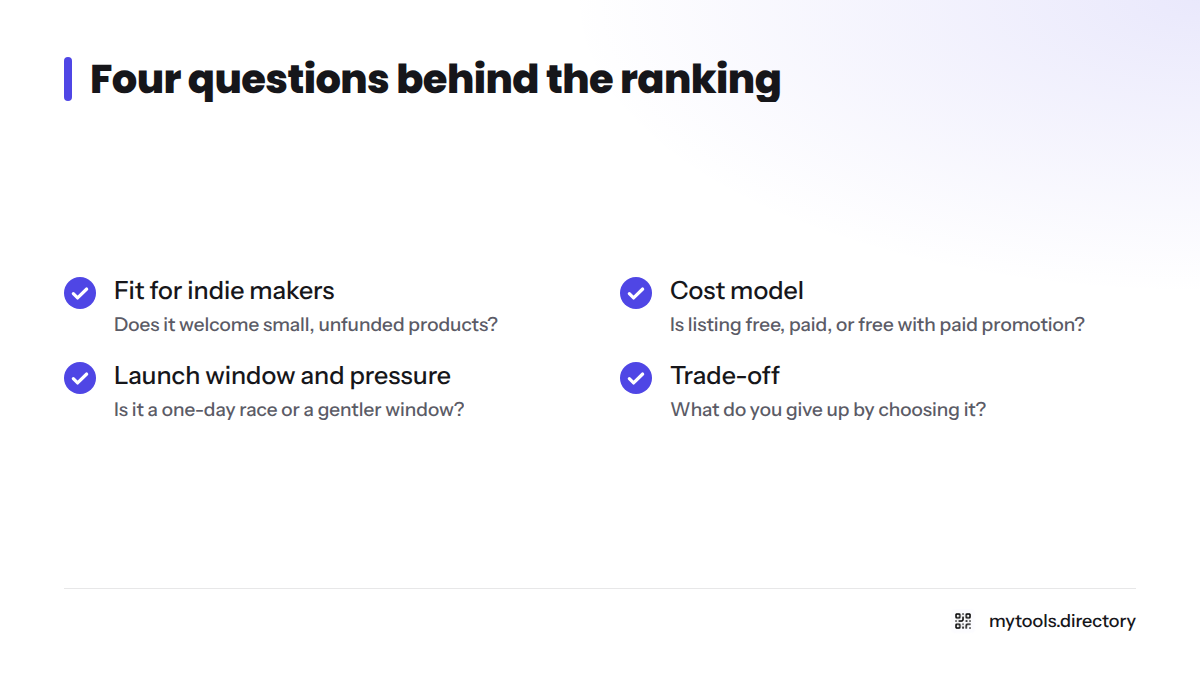
Four questions behind the ranking
I scored every platform on the same four questions:
- Fit for indie makers: does it welcome small, unfunded products?
- Cost model: is listing free, paid, or free with paid promoted placement?
- Launch window and pressure: is it a one-day race or a gentler window?
- Trade-off: what do you give up by choosing it?
The ranking follows fit, not audience size. A huge audience you cannot reach helps nobody.
What I did and did not measure
MyTools shows me which launch platforms makers mention when they submit. I treat that input as qualitative on purpose. I will not invent counts, traffic numbers or domain scores, because I cannot back them up.
I reviewed each platform's public site on October 12, 2026. Terms and pricing shift often, so confirm the current cost model on the platform before you submit. Full reviews live on the individual listing pages. This page is the shortlist.
Disclosure: MyTools is itself a place to launch, so I have a stake in this topic. I rank on fit, and I say so plainly when a competitor is the better choice.
Why Indie Makers Look Beyond Product Hunt
Product Hunt runs on a daily leaderboard. Your product competes with everything else posted that day, and the format rewards makers who arrive with a ready audience, a hunter with reach, or a team that can rally votes within hours.
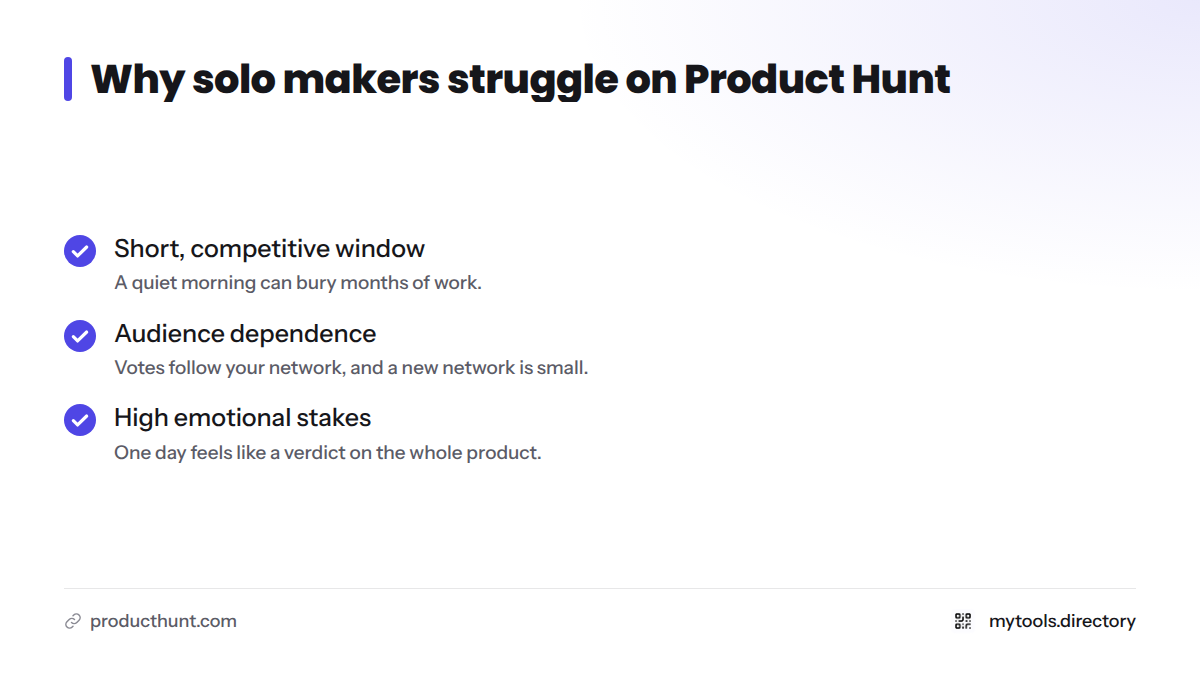
A solo founder with no following runs into three problems:
- A short, competitive window. A quiet morning can bury months of work.
- Audience dependence. Votes follow your network, and a new network is small.
- High emotional stakes. One day feels like a verdict on the whole product.
None of this makes Product Hunt bad. It still pays off when you have an existing audience, a product with broad consumer appeal, or a team that can show up all day. It is the wrong default when you have none of those. Plenty of makers launch there once, then lean on the quieter options below for steady discovery.
1. Uneed: Best for a Steady, Community-Voted Launch
Uneed lists products and lets the community vote on them, at a gentler rhythm than a single-day leaderboard.
- Best for: makers who want community voting without the all-or-nothing day.
- Cost model: check Uneed's site for its current free and paid options.
- Trade-off: a smaller audience than Product Hunt, so expect steady rather than explosive traffic.
See the Uneed launch platform details for the full review.
2. Microlaunch: Best for Small, Low-Pressure Launches
Microlaunch targets small products and early-stage launches. It suits a maker who wants a public launch without competing against well-funded teams.
- Best for: first-time launchers and side projects.
- Cost model: check Microlaunch's site for its current listing terms.
- Trade-off: lower visibility. Treat it as a practice run and a source of early feedback.
Read more on Microlaunch for small launches.
3. Tiny Startups: Best for a Simple Listing With a Founder Audience
Tiny Startups is a straightforward listing site, and most of its visitors are other founders and builders.
- Best for: a quick, no-fuss listing in front of fellow makers.
- Cost model: check Tiny Startups for current free and paid placement options.
- Trade-off: founders browse more than they buy, so expect feedback and peers before customers.
Details sit in the Tiny Startups listing review.
4. LaunchDirectories and AI Launch Space: Broad Reach vs. AI Focus
These two solve different problems. One casts a wide net. The other narrows it to AI products.
LaunchDirectories
- Best for: broad reach when you want your product listed in many places.
- Cost model: verify on the LaunchDirectories site, since terms vary.
- Trade-off: breadth can mean thin attention per listing, so submission quality matters more than volume.
AI Launch Space
- Best for: AI tools that want an audience already looking for AI products.
- Cost model: verify on the AI Launch Space site before paying for anything.
- Trade-off: a narrow niche. If your product is not clearly AI, it will not fit.
Building an AI product? Our AI-powered products catalogue shows how peers position theirs.
Beyond Directories: Hacker News Show HN, Indie Hackers and BetaList
Not every good launch surface is a directory. Three more deserve a spot in your plan:
- Hacker News Show HN: the Show HN guidelines say a Show HN is for something you made that people can run or try. Expect blunt technical feedback, which is gold for developer tools.
- Indie Hackers: Indie Hackers is a community where you can post launches and share progress. It pairs well with our build in public guide.
- BetaList: BetaList serves pre-launch products hunting early testers and waitlist signups.
Building a developer product? Our picks for developer tools for indie hackers show what others ship with.
Where to Launch a Startup Besides Product Hunt: Comparison and Picks
| Platform | Best for | Cost model | Trade-off | Checked on |
|---|---|---|---|---|
| Uneed | Steady community-voted launch | Verify on site | Smaller audience | Oct 12, 2026 |
| Microlaunch | Small, low-pressure launches | Verify on site | Lower visibility | Oct 12, 2026 |
| Tiny Startups | Simple listing, founder audience | Verify on site | Peers more than buyers | Oct 12, 2026 |
| LaunchDirectories | Broad directory reach | Verify on site | Thin attention per listing | Oct 12, 2026 |
| AI Launch Space | AI products | Verify on site | Narrow niche | Oct 12, 2026 |
| Show HN | Technical feedback | Free to post | Harsh, and not for every product | Oct 12, 2026 |
| Indie Hackers | Community, build in public | Verify on site | Slow, relationship-driven | Oct 12, 2026 |
| BetaList | Pre-launch testers, waitlists | Verify on site | Pre-launch only | Oct 12, 2026 |
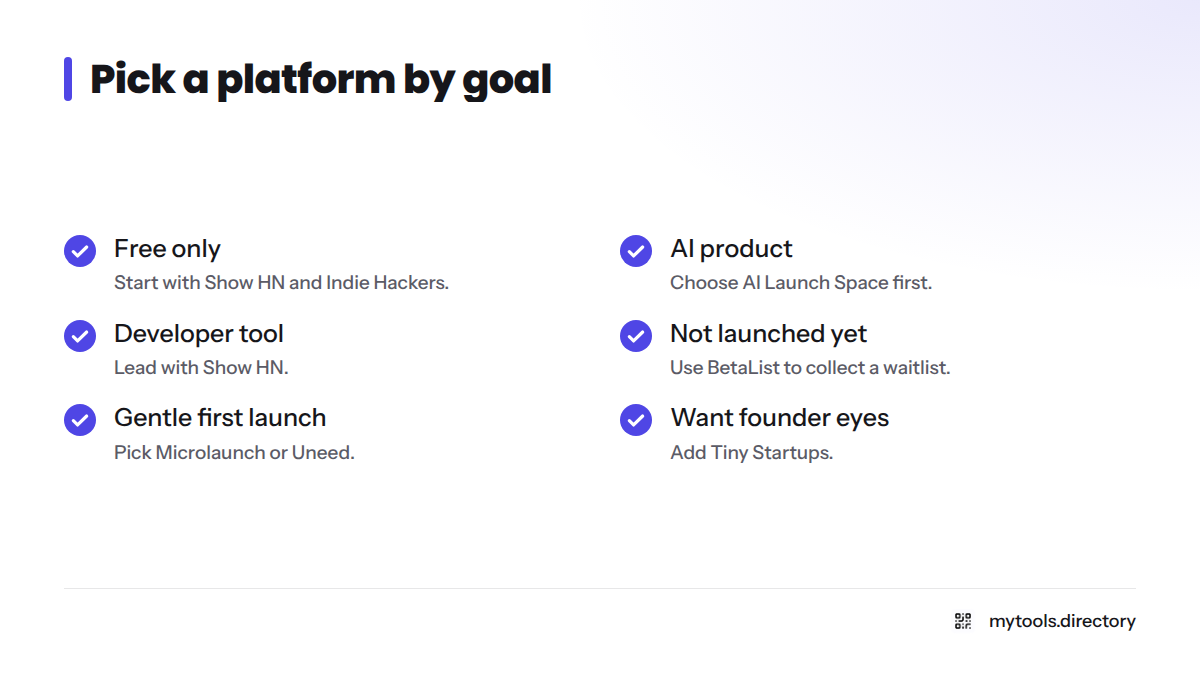
Pick by goal
Run down this checklist and stop at the first match:
- Free only? Start with Show HN and Indie Hackers, then check the free tiers on the directories.
- AI product? Choose AI Launch Space first.
- Developer tool? Lead with Show HN.
- Not launched yet? Use BetaList to collect a waitlist.
- Need a gentle first launch? Pick Microlaunch or Uneed.
- Want founder eyes on it? Add Tiny Startups.
Stack three, not one
My advice: skip the single-platform bet. Stack three. Use one directory for steady listing (Uneed), one community venue for conversation (Indie Hackers or Show HN), and one pre-launch venue (BetaList) if you have no users yet. Space them over several weeks so each gets your full attention. Our index of startup directories and launch platforms lists more options, and a launch checklist and a free launch sites guide are coming to the same site.
Ready? Submit your product to MyTools and add it to your stack.
FAQ
It can be, if you already have an audience or a team to rally votes during the one-day window. Without those, results are unpredictable. Many indie makers launch there once and rely on gentler platforms for steady discovery.
Yes. Hacker News Show HN is free to post, and Indie Hackers lets you share launches at no cost. Several directories offer free listings too, sometimes with paid promotion on top. Check each platform's current terms before submitting.
I have not verified specific subreddit threads, so I will not point you to one. Search Reddit for your product category plus "launch" and read recent posts. Treat any advice as opinion, and check each platform's current terms yourself.
They can add visibility and referral traffic, but results depend on how each site treats links. Do not expect a ranking boost from every listing. Our launch-platforms index points to deeper guidance on link behavior.
Next Steps
You do not need a perfect launch. You need a place to start that matches your budget, your audience and your product. Pick one directory, one community and one pre-launch venue, then submit your product to MyTools to get it in front of other indie makers today.